

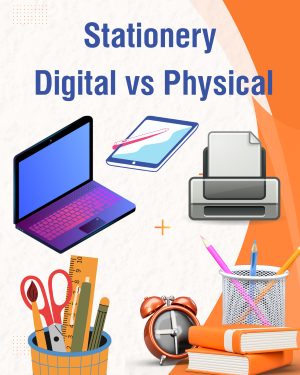
The scarcity of handmade materials and physical materials even in the age of technology
1. Introduction: Digital vs. Physical—The Place of Friends
In today’s world, devices, tablets, and cloud storage have made our lives completely digital. Yet, stationery—such as clocks, pens, and calendars—remains an important part of people’s daily lives. This raises the paradoxical question: “Why do we need stationery even in the digital age?”
In this article, we will understand this mystery and learn how physical stationery has its own unique charm and purpose.
2. Psychological Benefits: The Science of Handmade Expert
A. Better Memory and Learning
Neurological Benefits : According to research, handmade experts have an abundance of cognitive nuclear activity in the brain, which is 30% more than digital ones.
Document evaluation: According to a study (University of California), students who teach handwritten notes have a 35% better memory.
Improvement in the number of children: Hand-writing allows the brain to be in a “free-flow” mode for imagination and problem-solving.
B. Limitations of technology
Fatigue: Working on screens for long hours puts pressure on the eyes and brain.
Distraction: The constant buzz of notifications and apps disrupts focus.
Tactile file: The touch and smell of physical stationery gives a sensory experience that digital devices cannot .
3. Role in education and productivity
A. Important for students
Handwriting plot: Apart from digital tools, gadgets and projects have a hand-in-hand learning.
Focused study: Students who study remain focused on the study.
Memory encoding: Handwritten notes activate both visual and motor memory.
B. Business and Community Use: All India Calendar and Platter Time Museum.
Brainstorming: Whiteboard or sticky notes used to document teamwork.
Presentation: Handmade charts or drawings are more effective presentation materials.
4. Business Stationery and Peace of Mind
Nostalgia: Old diaries, letters, or old wrapping paper serve as templates for people to remember.
Personal Touch: Handwritten cards or notes have a personal touch, which is different from digital messages.
Mindfulness: People who write with a pen frequently go into a meditative state, which reduces stress.
5. Sustainability and Environment
Plastic-Free Living: Selling digital stationery (like recycled paper) is less harmful to the environment.
Difference from Digital: Data centers’ energy consumption increases with every e-book or app downloaded, while physical materials are portable for a long time.
Reuse enablement and repair: It is easy to fix demo pens or reuse old stock, whereas repurposing tech is costly.
6. Coexistence of digital and television
Hybrid model: Many people use a mix of digital tools + handwritten reminders .
Digital innovation: Creating coloring books or personalized stationery by printing digital designs.
Future specific trends: Development of interactive statistics with AR (augmented reality) and AI.
7. Indian context: Cultural diversity of stationery
Importance of festivals and rituals: Importance of traditional stationery like wedding cards, marriage certificates, or panchang.
Supporting small communities: Handmade stationery made by local artisans (e.g. bamboo pens, diaries).
Education system: Handwriting is mandatory in CBSE / State board exams.
8. Conclusion: Why stationery even in the digital age?
Stationery is not a tool—it is a medium for expressing human experience, personality, and emotion. Digital technology has fast life, but the similarity and depth of hand-to-arm is still a god. In the future, stationery and technology will increasingly collaborate, but each will have its own place.
“The scraps of paper, the rustle of a pen, and a partner’s blank page—the little moments are what make us human.”